Working Principle:
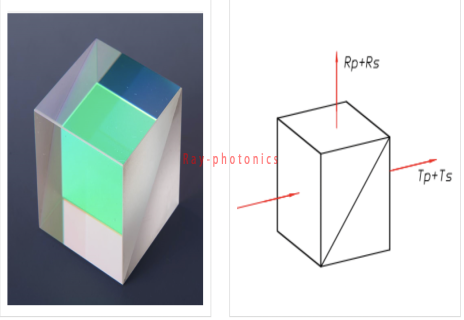
Using thin-film interference or birefringence (such as with Wollaston prisms and Glan-Taylor prisms), incident light is decomposed into:
S-polarized light (perpendicularly polarized, reflected light)
P-polarized light (parallel polarized, transmitted light).
The splitting ratio is highly dependent on the polarization state. For example, a 50:50 PBS splits unpolarized light by polarization state, rather than by energy.
Features:
Polarization-dependent: The splitting effect is directly related to the polarization state of the incident light.
High extinction ratio: Ideally, the reflected light is pure S-polarized, and the transmitted light is pure P-polarized.
Applications: Laser systems, polarization imaging, optical isolators, quantum optics, and other fields requiring polarization control.