Rotating Linear Polarization
Sometimes it is necessary to change the existing polarization of an optical system. For example, laser light is typically horizontally polarized. This can be a problem if the system requires the laser to be reflected from a metal surface, as mirrors are best suited for vertically polarized light. The solution? A half-wave plate with a 45° axis rotates the polarization to vertical.
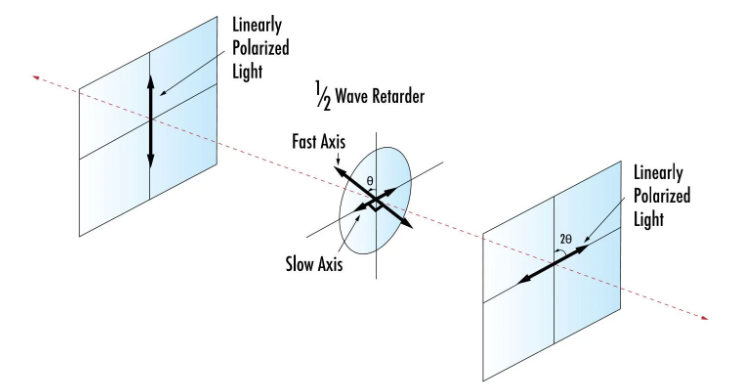
Another example is when the polarization axis needs to be adjusted to any other orientation. Rotating the waveplate axis by an angle of θ from the incident polarization will rotate the outgoing polarization by 2θ. Because the waveplates are highly parallel, inserting or rotating a half-wave plate can reconfigure the entire optical setup without realignment.
Transforming between Linear and Circular Polarization
Transforming between Linear and Circular Polarization
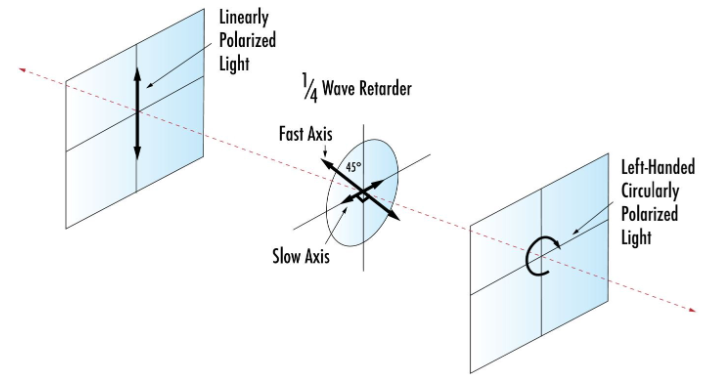
By positioning the linear polarizer and quarter-wave plate in a certain way, linearly polarized light can be converted to circularly polarized light, and vice versa. For example, a λ/4 waveplate with its axis at 45° to linear polarization will produce circular polarization. Passing the quarter-wave plate with undefined circular polarization will produce linear polarization at 45° to the waveplate axis. Furthermore, if linearly polarized light enters the λ/4 waveplate at any angle other than 45°, it will become elliptically polarized light.
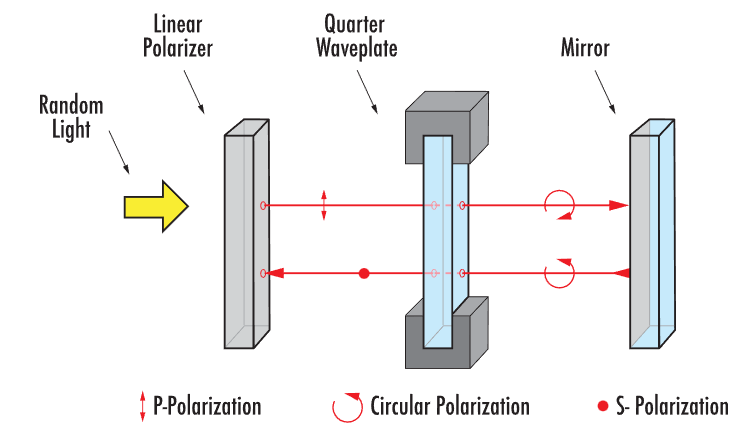
Light Isolation with a Linear Polarizer: A linear polarizer plus a λ/4 waveplate form an optical isolation system, in which light polarized by the linear polarizer passes through the λ/4 waveplate without attenuation but is converted to circular polarization. If reflected from a mirror, the circularly polarized light encounters the waveplate again and returns to linear polarization, but rotated 90° (Figure 13). Note: Two passes through the λ/4 waveplate are equivalent to one pass through the λ/2 waveplate. The redirected light is rejected by the linear polarizer. This system uses a dual-pass technique to eliminate feedback.
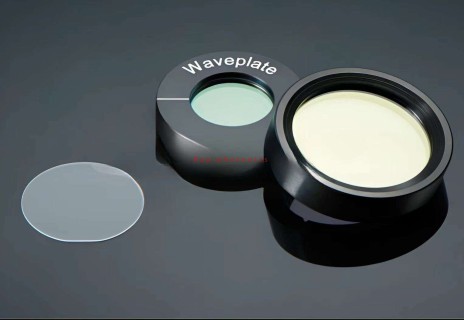
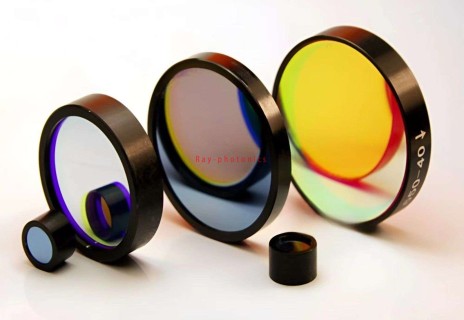
Wave plates are ideal for controlling and analyzing the polarization state of light. They come in three main types—zero-order, multi-order, and achromatic—each offering unique advantages depending on the application at hand. This article will cover how to use wave plates, including half-wave plates and quarter-wave plates, along with practical examples. Understanding how to use wave plates will help you choose the right wave plate and apply it effectively.